The Best Way to Cool a Bedroom Without Wrecking Your Sleep
Most Australian homes already have or are choosing a split system — the real decision is what to do when you don't have one yet, and how evaporative cooling fits your specific climate.
By KeepCoolExpert Team · Updated 14 October 2026
Cooling a bedroom is not the same problem as cooling a living room. In a living room you mostly care about raw cooling power. In a bedroom, three other things matter just as much: noise, because you have to sleep next to the thing; running cost, because it’s often on for 7–8 hours straight, every night, for months of the year in most of Australia; and safety, because it’s unattended while you’re asleep.
Start with what you’ve already got, not what to buy
Unlike a lot of cooling advice written for milder climates, the first real question for most Australian readers isn’t “should I get air conditioning” — it’s “do I already have it, and is it set up right for a bedroom specifically.” Work through these before comparing any new unit:
- Does your home already have a split system, and does it actually reach the bedroom well? A living-area unit that barely cools the hallway isn’t doing the bedroom much good at 2am. A dedicated bedroom unit, even a small one, usually beats a big one two rooms away.
- If you’re renting without one, what’s actually possible? Many rentals now have split systems as standard, especially newer builds, but plenty of older housing stock still doesn’t. Check your lease and current state tenancy rules — some allow a tenant-arranged installation with landlord consent — before assuming you’re stuck with portable options only.
- How dry or humid does your area actually get in summer? This one genuinely changes the right answer, more than almost anywhere else this site covers. Perth and inland regions are dry enough that evaporative cooling is a real, popular, effective option. Brisbane, Darwin, and the humid coastal strip are not — evaporative cooling underperforms there regardless of what the box says.
The realistic options, ranked for how Australians actually cool a bedroom
This ranking is deliberately different from how we’d rank it for a UK or Irish reader. There, a fan is usually the sensible default and AC is the exception. Across most of Australia, summer heat is intense enough for long enough that a fan alone genuinely isn’t sufficient for a big share of the country — it’s a supplement to real cooling, not a substitute for it, for most of the year in most regions.
1. Split-system reverse-cycle air conditioning — the realistic default
If you can install one (own the property, or your rental situation allows it), a split system is quieter at the indoor unit than any portable alternative, cheaper to run per hour of cooling, and doubles as efficient heating in cooler months and regions. This is genuinely the starting assumption for most Australian homes, not an aspirational upgrade — the real decision is usually sizing and placement (a bedroom-specific unit, correctly sized for that room) rather than whether to get one at all.
2. Evaporative cooling — mainstream, but only in the right climate
In dry inland and southern regions, evaporative (“swamp”) cooling is a genuinely popular, effective, and cheap-to-run choice — it’s not a niche fallback there the way it is in humid climates. In humid coastal and tropical regions, the same unit performs poorly, because there’s already too much moisture in the air for evaporation to cool it much. This is the single biggest way this guide differs by where in Australia you actually live — check your regional humidity, not just a spec sheet, before choosing this route.
3. Portable air conditioning — for renters and single-room gaps
Where a split system isn’t possible — an older rental without one, a share house, a room a whole-house system doesn’t reach well — a portable unit is the practical fallback. The trade-offs are the same everywhere: noise (the compressor sits in the room with you), an exhaust hose that has to vent somewhere, and a genuinely heavier unit than “portable” suggests, so check you’re comfortable moving it before buying.
4. A good pedestal or circulator fan — supplementary, not standalone, for most of the country
A fan is cheap to run and genuinely useful — but for most of Australia, treat it as something that makes a split system or evaporative cooler feel more comfortable at a lower thermostat setting, or gets you through a mild night, rather than something that stands alone against a proper summer. In milder regions (Tasmania, parts of Victoria) it holds up as a sole solution more of the time.
A quick decision matrix
| Your situation | Start with |
|---|---|
| Home already has a split system | Check it actually reaches the bedroom well, and is sized for that room specifically |
| No split system, dry inland/southern climate (Perth, Adelaide, inland NSW/VIC) | Evaporative cooler — genuinely effective here, not a compromise |
| No split system, humid coastal/tropical climate (Brisbane, Darwin, far north QLD) | Portable AC — evaporative won’t perform in this humidity |
| Any situation, as a supplement | A good circulator fan, to make whatever else you have feel more effective |
Not sure how much cooling power a room actually needs? Use our room-size calculator — it factors in room dimensions and sun exposure to give you a recommended range rather than just a guess.
Worth considering

EWT
EWT 3.3kW Portable Air Conditioner
Full review →From A$799.00
4.5★ (6 reviews) on JB Hi-Fi
- + 3.3kW cooling, rated for rooms up to 22m² — check this against your actual room with our room-size calculator
- + Uses R290 refrigerant rather than older HFCs — lower environmental impact
- + 24-hour timer and 3 fan speeds, with a dehumidifying mode for humid coastal nights
- − 4.5★ is from only 6 reviews — a genuinely good rating, but thin sample size compared to how heavily-reviewed split-system units are
- − At 24kg it's genuinely heavy to move between rooms despite being called portable — check you're comfortable shifting that weight before buying
- − Only 1-year manufacturer's warranty — short next to some split-system alternatives that carry 5+ years
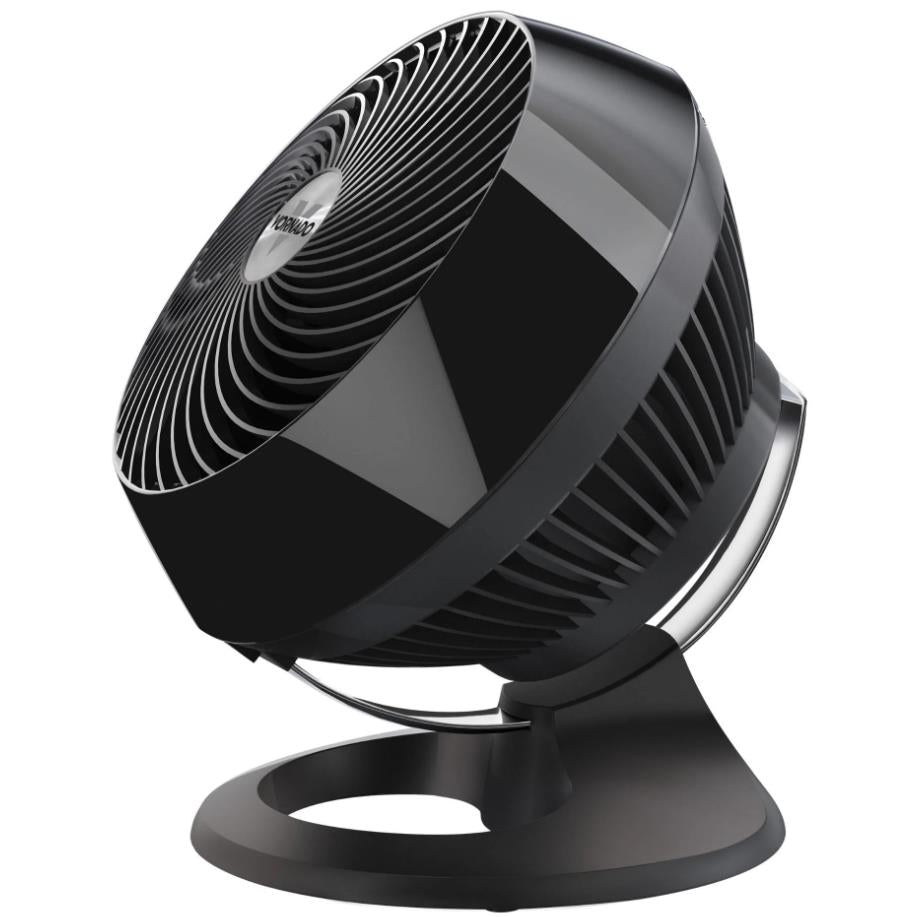
Vornado
Vornado 660 Air Circulator Floor Fan
Full review →From A$279.00
4.7★ (32 reviews) on JB Hi-Fi
- + 4.7★ from 32 reviews on JB Hi-Fi — the best-reviewed fan we found in this search, not just the best-marketed one
- + Vortex airflow circulates a whole room (rated up to 30.5m of throw) rather than just blowing directly on one spot
- + 5-year manufacturer's warranty — well above the 1–2 years typical of cheaper pedestal fans
- − No remote control or oscillation — it's a fixed-position circulator you aim once and leave, not a bedside fan you adjust from bed
- − No app control or smart features — this is a straightforward mechanical fan, not a connected one
Frequently asked questions
- Is evaporative cooling actually any good in Australia?
- Depends entirely on where you live. In dry, low-humidity regions — Perth, Adelaide, and much of inland NSW and Victoria — evaporative cooling genuinely works well and is popular for good reason: cheap to run, and it cools by adding moisture to dry air rather than fighting humidity. In humid coastal and tropical regions — Brisbane, Darwin, far north Queensland — it underperforms badly, because the air is already too moist for evaporation to do much cooling. Check your region's typical summer humidity before buying, not just the marketing.
- Do most Australian rentals already have air conditioning?
- It's genuinely more common than not in many parts of the country, and split systems are increasingly standard in newer rental builds — but it's not universal, especially in older housing stock. If your rental doesn't have one, check your lease and your state's current tenancy rules before assuming you can't install anything; some situations allow a tenant-arranged installation with landlord consent, separate from whether the landlord is obliged to provide one.
- What noise level should I look for in a bedroom cooling unit?
- Aim for 42dB or below on the lowest fan speed — roughly the level of a quiet library. Most manufacturer decibel ratings are measured at the loudest setting, so check the spec sheet for the low-speed or 'night mode' figure specifically, not just the headline number. Split systems are usually quietest at the indoor unit; portable units are almost always louder, because the compressor sits in the room with you.