How to Choose a Portable Air Conditioner
Portable AC solves a real problem — cooling without an outdoor unit or permission from anyone — but the category has genuine trade-offs a spec sheet won't tell you about. Here's what actually matters before you buy.
By KeepCoolExpert Team · Updated 14 October 2026
A portable air conditioner is the only real air conditioning option most renters and apartment-dwellers can actually install themselves — no outdoor unit, no management company or landlord permission, no professional fitting. That convenience comes at a real cost in efficiency and noise compared to a split system, and the category has a handful of buying traps that don’t show up on a spec sheet or a five-star rating.
Start with your constraints
Whether portable AC is even the right category for you depends on what you’re comparing it against and how you’ll actually vent it — not on which specific unit has the best reviews. Work through these first:
- Have you actually ruled out the alternatives? If you’re just cooling a bedroom at night, a fan is cheaper to run and often enough on its own — see our cooling a bedroom guide. If you can install a split system, it’s quieter and cheaper to run per hour of cooling. Portable AC is the right answer specifically when you can’t do either.
- Where will the exhaust hose actually go, day to day? A window kit that has to be removed and refitted every time isn’t a small inconvenience if you’ll be doing it daily through a whole summer.
- Do you care about running cost, or just upfront price? This affects the single-hose/dual-hose decision below more than almost anything else.
The buying criteria that actually matter
Most portable AC comparisons focus on BTU and price alone. Noise, hose configuration, and drainage matter just as much for how much you’ll actually like living with one.
1. Single-hose vs dual-hose — the trade-off most listings don’t mention
A single-hose unit draws the air it uses to cool its own condenser from inside the room, then exhausts that air outside through the hose. That creates slight negative pressure in the room, which pulls warm, humid air back in through any gap — under doors, around windows — undoing some of the cooling. A dual-hose unit draws that air from outside instead, avoiding the effect entirely. Dual-hose units cost more and are less common, but they’re genuinely more efficient in practice than the BTU rating alone would suggest.
2. Sizing: bigger isn’t automatically better
Undersizing leaves a room that never quite gets cool. Oversizing causes short-cycling — the unit blasts the room cold quickly, switches off, and hasn’t run long enough to properly remove humidity, leaving the room feeling cold but clammy rather than genuinely comfortable. Floor area alone doesn’t tell you enough; ceiling height, sun exposure, insulation and occupancy all shift the real number.
3. Noise
Most portable units sit around 50–55dB, noticeably louder than the 42dB comfort threshold worth aiming for in a bedroom specifically. If it’s going in a room you sleep in, check the low-speed or “sleep mode” decibel figure on the spec sheet, not the headline number, which is usually measured at full power.
4. Drainage — self-evaporating vs manual emptying
Self-evaporating models expel most condensate as vapour through the exhaust hose, so the tank rarely needs attention in normal use. Cheaper or older models, or any unit worked hard in genuinely humid conditions, may still need the tank emptied periodically. Worth checking specifically if you don’t want that added to your routine.
5. Running cost
Portable AC is the least efficient of the AC options precisely because of the single-hose effect above, and because the compressor itself sits inside the cooled room, adding its own heat to the space it’s trying to cool. Budget for higher running costs than a split system doing the equivalent job, especially if you’re running it most of the day rather than just overnight.
A quick decision matrix
| Your situation | What to prioritise |
|---|---|
| Running cost matters more than upfront price | Dual-hose, even at a higher purchase price |
| It’s going in a bedroom | Check the low-speed dB figure, not the headline number |
| You don’t want to think about it day to day | A self-evaporating model, so tank-emptying isn’t a routine chore |
| You’re not sure of the BTU you need | Use our room-size calculator rather than going by floor area alone |
Worth considering
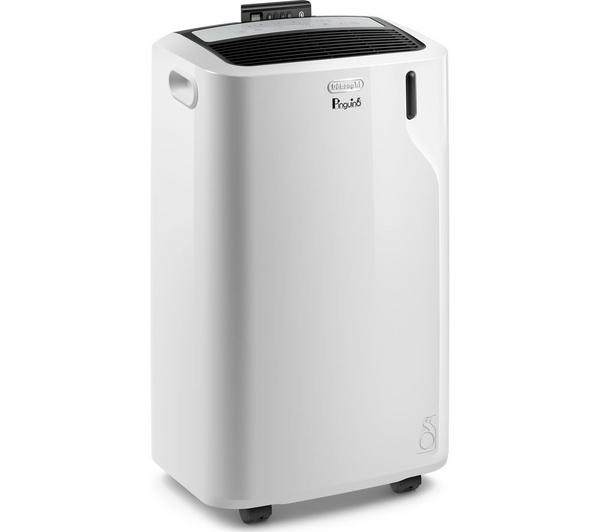
De'Longhi
De'Longhi Pinguino EM90 ECO Portable Air Conditioner, 9800 BTU
Full review →From €799.99
4.3★ (76 reviews) on Currys
Currently showing as sold out
- + 4.3★ from 75 reviews on Currys.ie — real, substantial social proof for the Pinguino range
- + Also works as a dehumidifier and a quiet-mode fan, not just cooling — useful across an Irish summer's more mixed weather
- + Class A energy rating and built-in wheels for moving it between rooms
- − Currently out of stock at Currys.ie — a genuine stock gap during peak season rather than a reflection on the product; Currys offers a back-in-stock email alert
- − At €799.99 it's a bigger outlay than budget single-hose units — reflects Ireland's more limited portable AC retail selection right now, not extra cooling power for the price
Frequently asked questions
- Should I get a single-hose or dual-hose portable air conditioner?
- Dual-hose if you can — it draws the air used to cool its condenser from outside rather than from the room, so it doesn't create the negative pressure that pulls warm, humid air back in through gaps under doors and windows. Single-hose units are cheaper and more common, and still work, but they're meaningfully less efficient in practice than their BTU rating alone suggests.
- What size (BTU) portable air conditioner do I actually need?
- More than you'd think from just floor area — ceiling height, sun exposure, insulation and how many people use the room all matter. Oversizing isn't free either: too much cooling power for the room means the unit short-cycles (switches off before it's run long enough to properly remove humidity), leaving the room feeling cold but clammy. Use our room-size calculator rather than guessing from area alone.
- Do I need to empty the water tank myself?
- Depends on the model. Many modern portable units are self-evaporating — most of the condensate gets expelled through the exhaust hose as vapour, so the tank rarely needs emptying in normal use. Cheaper or older models, or ones run hard in very humid conditions, may still need manual emptying every so often. Check this specifically if you don't want it on your to-do list.