The Best Way to Stay Cool Camping and at Festivals
Tents turn into ovens by mid-morning and there's no mains socket in sight. Here's what actually keeps a tent liveable, not just a fan that runs out of charge on night two.
By KeepCoolExpert Team · Updated 14 October 2026
Camping and festival cooling is a different problem to cooling a room at home, for one simple reason: there’s no mains power, and often no way to recharge for days at a time. That rules out almost everything on a normal cooling shortlist except battery- or USB-powered fans, so the real decision is about capacity, noise, and how you’re going to keep it charged — not about fan type.
Start with your constraints
What you actually need depends on trip length and recharging access, not on finding the “best” camping fan — a weekend with car access is a completely different problem to a week off-grid. Check these three things first:
- How many nights, and can you recharge at all? A weekend with a car nearby to charge from is a different problem to a week at a festival with no vehicle access and only occasional phone-charging points.
- Are you sleeping right next to it? Noise matters more in a tent than almost anywhere else — you’re a few feet from the fan and from anyone camping next to you.
- Are you carrying this any distance? Festival camping often means a walk from car park to pitch; a bulkier high-capacity fan is a real weight and space trade-off, not just a spec on a box.
The realistic options
For most trips, a clip-on tent fan is the right answer; size up to a high-capacity fan only for week-long stays with no recharging, and treat handheld/neck fans as a daytime extra rather than your main fan.
1. Clip-on tent fans — the default for most trips
A small fan that clips to a tent pole or guy rope, USB-C rechargeable, is the right starting point for the large majority of camping trips. Look for a genuine low/quiet mode — festival and campsite etiquette both reward a fan that isn’t audible three tents away.
2. High-capacity portable fans — for week-long trips with no recharging
If you’re away for a week or more with no reliable way to recharge, a higher-capacity battery (15,000mAh and up) buys you real runtime at the cost of extra size and weight. Worth it specifically when recharging isn’t an option; overkill for a two-night trip.
3. Handheld or neck fans — daytime only, not for sleeping
Great for queuing, walking between stages, or general daytime relief, but the airflow is too localised to meaningfully cool a tent overnight. Treat these as a second, complementary purchase rather than your only fan.
4. A separate USB power bank
If your fan’s battery isn’t swappable, a separate power bank effectively removes the runtime limit, as long as you have some way to recharge the bank itself (car, on-site charging point, or a solar panel for longer off-grid trips).
A quick decision matrix
| Your situation | Start with |
|---|---|
| Weekend trip, car access for recharging | A basic clip-on tent fan |
| Week-long festival, no recharging access | High-capacity fan (15,000mAh+) or a fan plus separate power bank |
| Just need cooling while up and about | Handheld or neck fan, alongside a tent fan for sleeping |
| Sharing a tent, or camped close to others | Prioritise a genuine quiet/low mode over maximum airflow |
Whatever fan you bring, ventilation does most of the real work: pitch in shade where you can, and open every mesh panel and vent before you rely on a fan to do the rest.
Worth considering
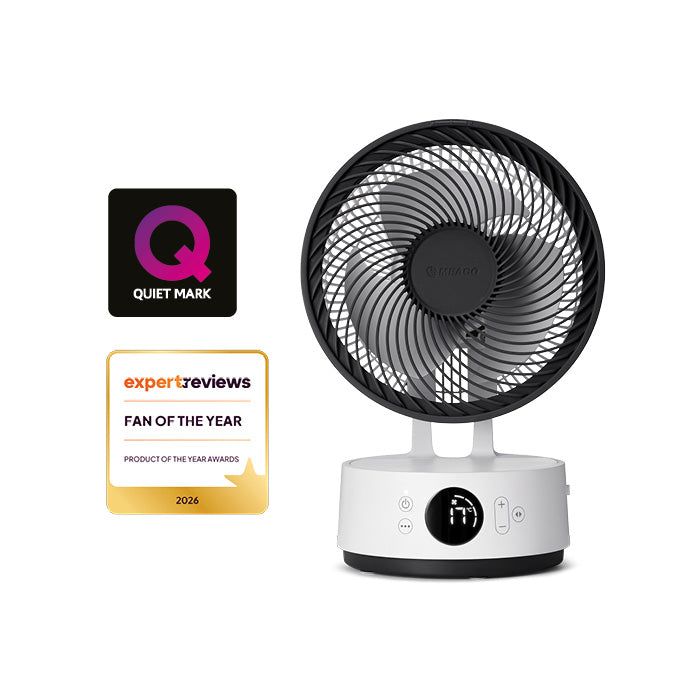
Meaco
MeacoFan Sefte 8-inch Portable Battery Air Circulator
Full review →From £79.99
- + Battery-powered — no mains socket needed, genuinely useful for camping and festivals
- + Includes a storage bag for travel
- + 3-year warranty as standard across the Meaco fan range
- − Battery-powered means a runtime trade-off — check the spec against how many nights you're away for
- − Sold out direct from Meaco, with the listing now saying back in stock February 2027 — still in stock via Air Con Centre at £79.99 as of 2026-10-14
Frequently asked questions
- How long will a battery-powered camping fan actually last?
- It depends entirely on battery capacity and speed setting: budget fans with a 4,000–5,000mAh battery typically run 5–15 hours, while premium 20,000mAh units can stretch to 24–50 hours on the lowest speed. For a weekend, a budget fan is fine; for a week-long festival with no way to recharge, size up or bring a separate USB power bank so the fan isn't your only power source.
- Will a tent fan actually cool the tent down, or just move hot air around?
- A fan doesn't lower the air temperature inside the tent — it cools you by moving air across your skin, the same as any other fan. The bigger win in a tent is usually ventilation: open every mesh panel and vent you have, and pitch in shade if you can, since a tent in direct sun will out-heat what any battery fan can compensate for.
- Is it safe to leave a battery fan running overnight in a tent?
- Yes — unlike mains-powered heaters or naked flames, a low-voltage battery fan doesn't carry a meaningful fire risk. The main practical issue is condensation: tents get genuinely damp overnight, so check your fan's IP rating if it'll sit near the tent wall, and wipe it dry before packing it away.