The Best Way to Cool a Bedroom Without Wrecking Your Sleep
A bedroom has different cooling priorities to every other room in the house: noise, safety, and running cost matter more than raw power. Here's how to choose.
By KeepCoolExpert Team · Updated 14 October 2026
Cooling a bedroom is not the same problem as cooling a living room, and treating it that way is the single most common mistake we see. In a living room, you mostly care about raw cooling power and even coverage. In a bedroom, three other things matter just as much: noise, because you have to sleep next to the thing; running cost, because it’s often on for 7–8 hours straight, every night, for weeks; and safety, because it’s unattended while you’re asleep.
Start with your constraints, not the unit
Three things decide which cooling type actually works for your bedroom: whether you can fit an outdoor unit, how sensitive you are to noise, and how hot and humid the room genuinely gets. Answer these before comparing products:
- Do you have access to an outdoor wall or window you’re allowed to modify? Renters and flat-dwellers often don’t — that rules out split systems and narrows you to portable AC, evaporative coolers, or fans.
- How sensitive are you to noise? If you wake at the hum of a fridge, decibel rating should be your first filter, not BTU.
- How hot and how humid does the room actually get? A north-facing bedroom in a Victorian terrace and a west-facing loft conversion are different problems even in the same city.
The realistic options, ranked by what most bedrooms need
For most UK bedrooms: start with a good fan, step up to portable air conditioning only if the room genuinely gets too hot for that, and consider a split system solely if you can actually get one installed. Evaporative coolers are a niche, dry-climate option, not a general substitute for AC.
1. A good tower or pedestal fan — the default starting point
For the majority of UK bedrooms, even in a heatwave, a well-placed fan is enough to make sleep bearable, and it costs pennies a night to run. Look for a model with a genuine sleep/night mode (quieter, dimmer or no display light) and a timer. This should be your first purchase, not your last resort — even people who end up buying AC usually keep a fan for shoulder-season nights when full AC is overkill.
2. Portable air conditioning — for rooms that get properly hot
If your bedroom regularly sits above 26–28°C at night, a portable AC unit is the next step up. The trade-off is noise (most sit around 50–55dB, well above the 42dB comfort threshold) and the exhaust hose, which has to vent somewhere — usually a window kit that leaves a permanent gap when the unit isn’t in use. Run it on a timer to pre-cool the room before bed rather than all night on full power. If noise is the deciding factor, Meaco’s new Cirro range is marketed on quieter running, but the figures on the box and the figures a reviewer measured don’t match; see how loud the Cirro really is before relying on them.
3. Evaporative coolers — only in the right climate
Evaporative coolers are cheap to run and add welcome moisture in a dry room, but the UK’s typically moderate-to-high humidity means they underperform compared to how they’re marketed. They’re a reasonable option in a small, dry, well-ventilated bedroom, but not a substitute for AC in a humid heatwave.
4. Split-system air conditioning — the quietest, most efficient option, if you can install one
Where installation is possible (house with garden access, leasehold with permission, or new-build with provision), a split system is quieter at the indoor unit than almost any portable alternative, and considerably cheaper to run per hour of cooling. The catch is upfront cost and installation — this is a considered purchase, not an impulse one during a heatwave.
A quick decision matrix
| Your situation | Start with |
|---|---|
| No outdoor access, moderate heat | Tower fan, then consider evaporative cooler |
| No outdoor access, room gets very hot | Portable AC with window venting kit |
| Own the freehold / have permission for external unit | Split system |
| Light sleeper, any scenario | Prioritise decibel rating over BTU in whatever you choose |
Not sure how much cooling power your room actually needs? Use our room-size calculator — it factors in your room’s dimensions, sun exposure, and constraints like outdoor access to give you a BTU range and a recommended cooling type, rather than just a number.
Worth considering
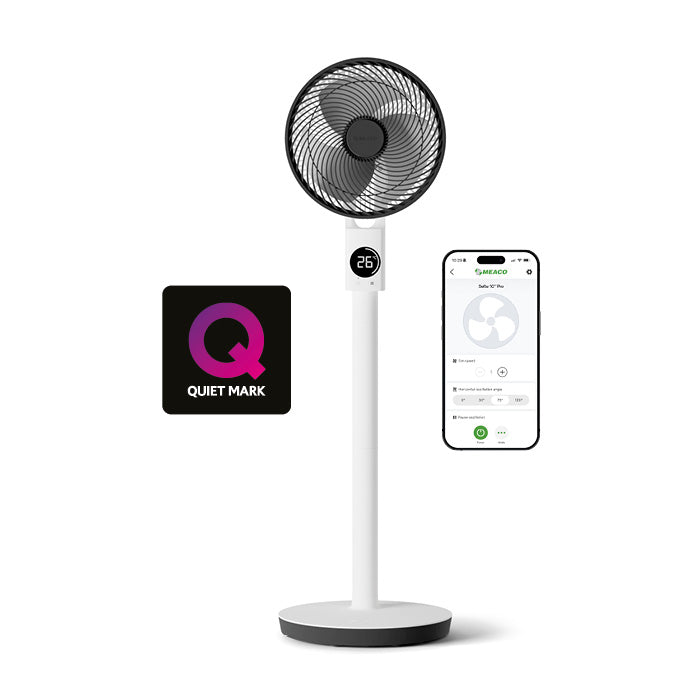
Meaco
MeacoFan Sefte Pro 10-inch Pedestal Air Circulator
Full review →From £199.99
- + Pedestal height suits bedroom or living room placement better than a desk fan
- + 3-year warranty as standard across the Meaco fan range
- − Costs meaningfully more than Meaco's standard 10-inch pedestal (£179.99) — worth checking whether the extra features justify it for your use case
- − Sold out direct from Meaco, with the listing now saying back in stock January 2027 — still in stock via Air Con Centre at £199.99 as of 2026-10-14
Frequently asked questions
- Is it safe to leave a portable air conditioner running all night?
- Most modern portable and split-system units are safe to run overnight — look for one with a sleep/quiet mode and a built-in timer so it can step down or switch off a few hours before you'd naturally wake up. Older or poorly maintained units are more of a fire-risk concern than anything inherent to running overnight; keep the filter clean and don't run it through a stretched extension lead.
- Will a fan actually cool the room, or just move warm air around?
- A standard fan doesn't lower the air temperature at all — it cools you by increasing evaporation from your skin. That's genuinely effective for sleep comfort at a fraction of the running cost of AC, but it stops working as well once humidity is high or the room is above roughly 30°C.
- What noise level should I look for in a bedroom AC unit?
- Aim for 42dB or below on the lowest fan speed — that's roughly the level of a quiet library. Most manufacturer decibel ratings are measured at the loudest setting, so check the spec sheet for the low-speed or 'sleep mode' figure specifically, not just the headline number.